
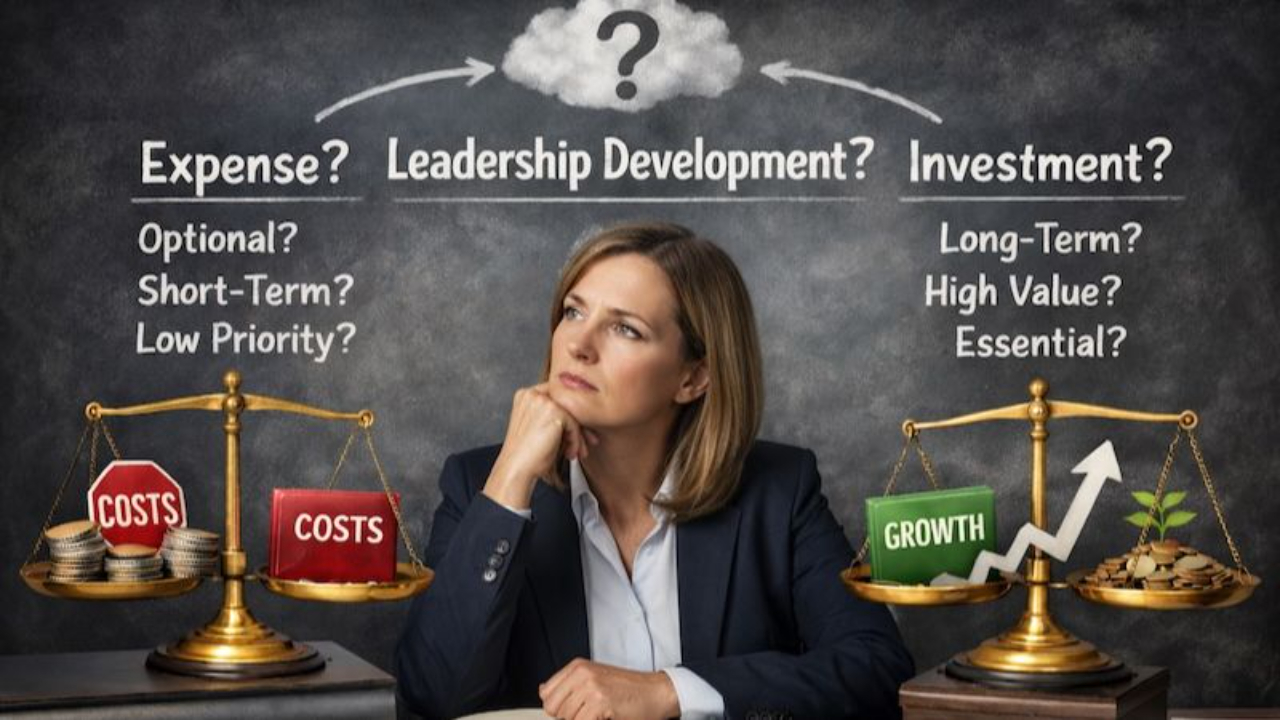
Leadership Development in Banking: Discretionary Expense or Essential Infrastructure?
Banks are no strangers to discipline.
Capital ratios matter. Margins are watched closely. Expenses are scrutinized line by line. In an environment shaped by regulation, interest-rate pressure, and heightened competition for both customers and talent, leaders are expected to be prudent stewards of every dollar.
That discipline is necessary.
But it also raises an important question—one that banking leaders should revisit regularly:
Is leadership development a discretionary expense, or is it essential infrastructure?
Why Leadership Development Is Often Misclassified
In banking, leadership development is sometimes grouped with “soft costs”—training, coaching, or professional development that appears optional when compared to technology investments, compliance requirements, or branch operations.
On the surface, that categorization feels logical. Leadership development doesn’t show up as a line item tied directly to loan growth, deposit acquisition, or fee income. It doesn’t produce immediate, easily measurable ROI.
Yet that framing misses something critical.
Banks do not grow—or struggle—because of strategy alone. They succeed or fail based on execution, and execution is entirely dependent on leadership behavior.
Banking Is a Relationship Business—Led by People
Despite technology, automation, and digital channels, banking remains a deeply human business. Trust, judgment, and communication sit at the center of every meaningful transaction.
Leadership development directly influences:
-
How lenders engage clients in uncertain environments
-
How managers handle difficult performance conversations
-
How teams respond to regulatory pressure without becoming risk-averse or disengaged
-
How emerging leaders step into responsibility instead of avoiding it
When leadership development is active and reinforced, those behaviors strengthen. When it is paused, they often regress.
The Hidden Risk of Pausing Leadership Development
In banking, leaders are accustomed to managing visible risk. What’s less obvious—but equally real—is the risk of stalled leadership momentum.
Leadership development is cumulative. It builds through repetition, reinforcement, and application in real situations. When development work is interrupted:
-
Communication habits slowly erode
-
Accountability conversations get postponed
-
Managers revert to comfortable—but less effective—defaults
-
High-potential talent becomes frustrated or disengaged
The result isn’t dramatic failure. It’s something more dangerous: gradual underperformance that’s difficult to diagnose and even harder to reverse.
Restarting leadership development later often costs more time and energy than maintaining it in the first place.
Leadership Development Is Not Training—It’s Behavior Change
Effective leadership development in banking is not about theory, personality assessments, or motivational messaging. At its best, it is about behavior change:
-
How leaders think through decisions
-
How they communicate expectations
-
How they handle tension, pressure, and ambiguity
-
How they build confidence in others
Those behaviors directly affect customer experience, team stability, and long-term performance—even if they don’t appear neatly on a dashboard.
Banks that treat leadership development as infrastructure understand this truth:
Strong leadership reduces risk, improves execution, and protects culture.
A Better Question for Banking Leaders
Rather than asking, “Can we pause leadership development?” a more useful question may be:
“If we remove this, what weakens?”
If the answer includes decision quality, communication clarity, accountability, or talent retention, then the work is no longer discretionary—it is foundational.
Final Thought
Banking leaders are rightly cautious with resources. But prudence also means knowing what not to cut.
Leadership development—when embedded, trusted, and focused on real behavior—doesn’t distract from performance. It sustains it. In an industry built on trust, judgment, and relationships, that may be the most essential infrastructure of all.
Fred Reggie is a Business Strategy Coach and International Speaker specializing in Service Culture Development, Leadership, and Communication. He facilitates successful Mission Development workshops and retreats to elevate client brands. He is the Best-Selling author of “Tell Me... How to Initiate and Nurture MEANINGFUL CONVERSATIONS with Anyone, Anywhere, Anytime”. You can contact Fred through Email , connect on LInkedIn, or schedule a call to discuss how your company's Service Culture measures up.
