
Stop Running Every Play: Field Vision and the Handoff Mindset Every Executive Needs
What Modern Football Teaches Every Leader About Delegation, Judgment, and Coaching
Football has long been considered a male domain. That assumption is being challenged.
Women play competitive football at every level — from the Olympic-bound flag football programs now fielding elite female athletes ahead of LA 2028, to the Women's Football Alliance, to collegiate programs expanding across the country. The game is no longer defined by who has traditionally played it. It is defined by what it demands: field vision, split-second decision-making, the ability to read chaos and respond with precision, and the discipline to trust the people around you.
Those are not gendered skills. They are leadership skills.
And nowhere in football is that more evident than at the quarterback position.
There was a time when the role of the quarterback was elegantly simple: stand in the pocket, execute the play, and deliver the ball. Running was reserved for desperation, not strategy.
That era is over.
The modern quarterback has become one of the most dynamic decision-makers in professional sports. In the early 2020s, quarterbacks collectively accounted for roughly 15% of all team rushing yards and nearly 20% of rushing touchdowns. Dual-threat athletes such as Lamar Jackson, Jalen Hurts, Josh Allen, and Justin Fields have fundamentally redefined what it means to lead an offense. Since 2021, Hurts and Allen in particular have ranked among the most productive rushing quarterbacks in the league — in both yardage and touchdowns.
Yet here is the leadership principle that demands our attention:
Even the most mobile quarterback does not run every play.
A quarterback may carry the ball more often than their predecessors. They may be the most physically gifted athlete on the field. In certain moments, they may be the best option available. But if they attempt to become the entire offense — keeping the ball every time, trusting no one, operating as though the team exists merely to support their individual effort — the results are predictable: a limited offense, a vulnerable team, and a leader who has confused capability with wisdom.
The quarterback's role is not to demonstrate what they can do. Their role is to read the field, assess the opposition, understand the talent surrounding them, and make the best decision for the team in that moment.
That is also the role of the executive.
The Executive Who Runs Every Play
In my work coaching senior leaders and executives — women and men across industries — I encounter a consistent and costly pattern. Leaders who are talented, driven, and deeply committed to results, yet who have unconsciously positioned themselves as the singular force responsible for every decision, every problem, and every outcome.
Every significant challenge lands on their desk. Every decision stalls in their queue. Every personnel issue becomes their personal burden. Every client concern becomes their direct assignment.
In the early stages of a leadership role, this behavior can feel like accountability. Over time, it becomes something far more damaging:
- A team conditioned to wait rather than act
- Managers who hesitate rather than lead
- Employees who stop developing independent judgment
- An organization where the leader has become the primary bottleneck
This is not leadership. This is a leader running every play — and wondering why the team isn't advancing.
The Huddle: Where Leadership Actually Begins

Before a single play is called, before the offense lines up, before the quarterback reads the defense — there is the huddle.
The huddle is where leadership becomes visible in its truest form. It is not a monologue. It is not a directive issued from a distance. It is the leader leaning in — physically, mentally, intentionally — and bringing every person in that circle into a shared understanding of what is about to happen and why.
Look closely at what the huddle requires of the quarterback. They must communicate with clarity under pressure. They must read the room — who is confident, who needs steadying, who is ready to be trusted with a critical assignment. They must deliver the plan in a way that every person present can execute it without hesitation the moment the ball is snapped.
The huddle is not a meeting. It is a moment of alignment that makes execution possible.
Executives who skip the huddle — who move straight from strategy to execution without ensuring their teams are aligned, informed, and trusted — consistently wonder why their organizations underperform. The answer is almost always the same: the team was never truly in the huddle. They were simply told what play to run.
The best executive leaders build cultures where the huddle is sacred. Where alignment precedes action. Where every member of the team understands not just what they are being asked to do, but why it matters and how their role connects to the larger outcome.
That is not a soft skill. That is the foundation of high-performance execution.
The Wisdom of the Handoff
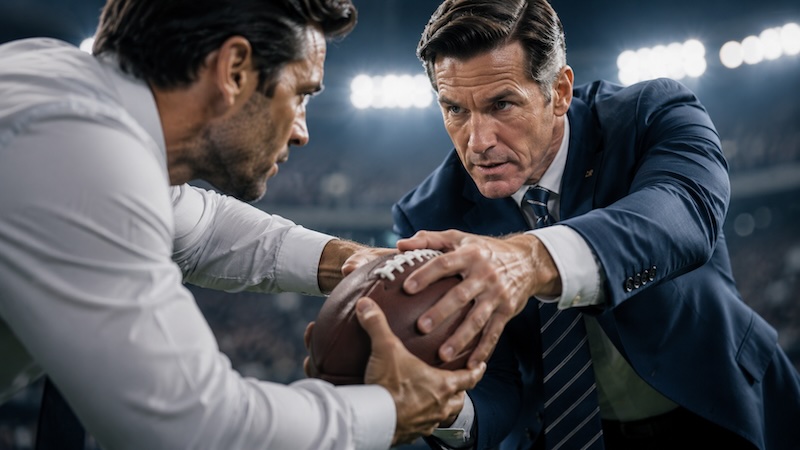
In football, the quarterback touches the ball on virtually every offensive play. That proximity to the ball does not mean they are meant to keep it.
The elite quarterback is a master of distribution. They hand off to the running back. They throw to the open receiver. They adjust the play at the line of scrimmage when the defense shifts. And yes — when the moment demands it — they tuck the ball and run with purpose.
The discipline lies not in knowing how to run. It lies in knowing when running is the right call.
This is the same discipline that separates exceptional executives from merely busy ones.
The best leaders are not those who do the most. They are those who make the best decisions about what to do and — equally important — who should do it. They understand who on their team can handle pressure. They recognize who is ready for expanded responsibility. They know who has the experience, creativity, or technical depth required for a given situation. They invest in developing the people around them precisely so that, when the moment arrives, the right person is positioned to succeed.
Reading the Field

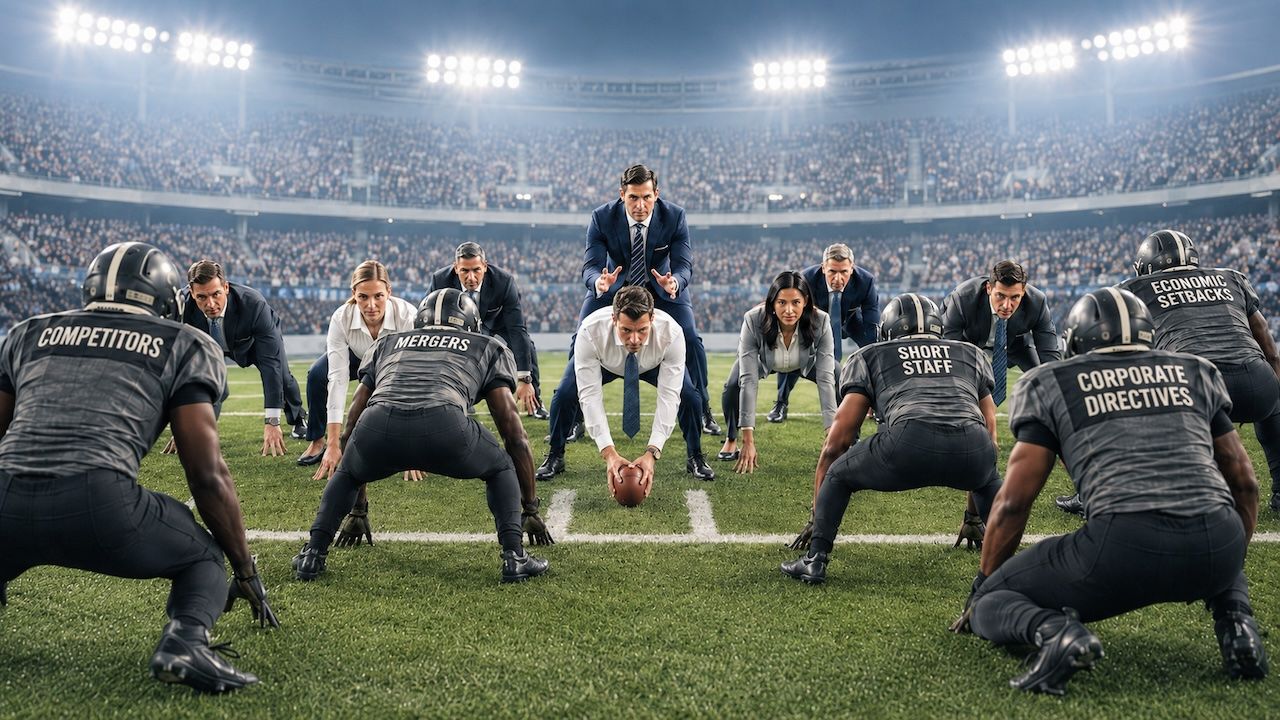
The opposition is never abstract. Look at what every executive team actually faces when they step to the line: competitors gaining ground, mergers disrupting operations, staffing shortfalls straining capacity, corporate directives shifting priorities, and economic headwinds that no one fully predicted. It is all there — visible, immediate, and unrelenting.
A quarterback does not step to the line and react to the defense in the moment of the snap. Long before that, they have studied film. They have anticipated pressure packages. They know which defensive schemes are most likely and what adjustments to make before and after the ball is hiked. By the time the play unfolds, the best decisions have already been made.
Executives must develop the same caliber of situational awareness.
Before acting, the effective leader reads:
- The market — Where is the opportunity? Where is the threat?
- The culture — What does the organization need right now? What is it capable of absorbing?
- The customer — What are clients communicating, both explicitly and implicitly?
- The team — Who is ready? Who is struggling? Who is being underutilized?
- The moment — Does this situation call for urgency, patience, boldness, or restraint?
Only after that assessment should the executive act — and that action must be a considered decision, not a reflexive default to personal involvement.
The questions worth asking in that moment:
- Do I retain this responsibility, or does it belong with someone else?
- Who on my team is better positioned to own this outcome?
- Is moving quickly the right call, or does slowing down serve us better?
- Do the circumstances require an audible — a change in direction?
- Am I running this play because it is the best play, or simply because I can?
Where Coaching Creates the Advantage
This is precisely where executive coaching delivers its greatest value.
A business coach does not take over the team. The coach does not step onto the field and execute the play on the leader's behalf. The coach's role is to help the executive see what proximity to the work has made difficult to see — including what happens before the huddle, inside the huddle, and at the line of scrimmage when the pressure is highest.
The coaching conversation often begins with a simple set of questions:
- Where are you holding the ball too long?
- Where are you absorbing hits that your team should be handling?
- Where are you failing to trust the people you hired and developed?
- Where are you running — not because it is the right play — but because running feels like progress?
- Where are you measuring your leadership by personal output rather than organizational performance?
- And critically: are you actually huddling with your team — or simply issuing plays from a distance and expecting flawless execution?
These questions are not comfortable. But they are essential. Because the executive who can answer them honestly is the executive who begins to lead at a level that others cannot reach without this kind of structured reflection.
Running With Purpose
Modern football has given us a more sophisticated leadership analogy than the old models allowed — and a more inclusive one.
The game is played by athletes of every background. It is led by coaches, coordinators, and quarterbacks who succeed not by dominating their teams, but by elevating them. And as women continue to claim their rightful place on the field and in the front office, the lessons football offers belong to every leader willing to learn them.
Yes, there are moments when the executive must step in directly — when the situation demands personal involvement, visible leadership, and decisive action taken at the highest level. Those moments are real, and leaders who shy away from them when they arise are not serving their organizations.
But direct action should be a deliberate choice, not the default response to every situation.
The goal is not to avoid running. The goal is to know — with clarity and conviction — when running is the right play.
That distinction separates the leader who is simply occupied from the leader who is genuinely leading.
The executive is part of the team. Not the whole team.
The quarterback is indispensable — but they are not the offensive line, the running back, the wide receiver, the tight end, or the defense. They cannot be all of those things and still perform their actual role with excellence.
When executives internalize this truth, something significant shifts.
They stop measuring their effectiveness by how much they personally carry. They begin measuring it by how well they prepare their people, position them for success, extend meaningful trust, and activate the full capability of the organization around them.
The huddle comes first. The read at the line of scrimmage comes next. And then — only then — does the play unfold with the full force of a prepared, aligned, and trusted team behind it.
Because the leaders who win — consistently, sustainably, at scale — are not the ones who run every play.
They are the ones who build the huddle. They read the field with clarity. They know their team deeply. They put the ball precisely where it has the best chance to advance.
And when the moment genuinely requires it, they run with purpose — because they chose to, not because they didn't know what else to do.
The best investment any leader can make is the discipline to ask: am I running this play because it's the right call — or simply because I can?
Fred Reggie is a Business Strategy Coach and International Speaker specializing in Service Culture Development, Leadership, and Communication. He facilitates successful Mission Development workshops and retreats to elevate client brands. He is the Best-Selling author of “Tell Me... How to Initiate and Nurture MEANINGFUL CONVERSATIONS with Anyone, Anywhere, Anytime”. You can contact Fred through Email , connect on LInkedIn, or schedule a call to discuss how your company's Service Culture measures up.
