
You Know Larry?
In the early 1970s, I was an assistant manager at Brennan’s Restaurant in New Orleans.
And Brennan’s was not just a busy restaurant. It was a world-famous restaurant—particularly known for breakfast.
On an average day, we might serve 1,100 or 1,200 people for breakfast and lunch, and another 600 at dinner.
During Mardi Gras, the French Quarter was even more chaotic.
The streets were crowded. People were celebrating. People were drinking. And some people had apparently decided that good judgment was something they would pick up again after Ash Wednesday.
So, during Mardi Gras, Brennan’s hired two off-duty New Orleans police officers to watch the front door.
Over time, I got to know them pretty well. We would feed them, visit with them and give them a little break from the activity outside.
One of those officers was a motorcycle policeman named Larry Pridgen.
At the end of one Mardi Gras season, Larry handed me his New Orleans Police Department business card. He said, “Fred, keep this with you. If you ever get stopped, show them my card. You’ll be all right.”
Now, I thought that was a pretty valuable card to have. So I put it somewhere very safe. So safe that I never saw it again.
Four or five years passed.
By then, I was working for a New Orleans tour and transportation company near Interstate 10, and one afternoon I had an appointment at the New Orleans Lakefront. I left the office at almost exactly four o’clock.
At that time of day, to control traffic, the city would lower a barricade across one of the interstate entrance ramps. As I approached, the arm was coming down and I was already running late. In that moment I made one of those decisions that seems perfectly logical—for about three seconds. I drove around the barricade.
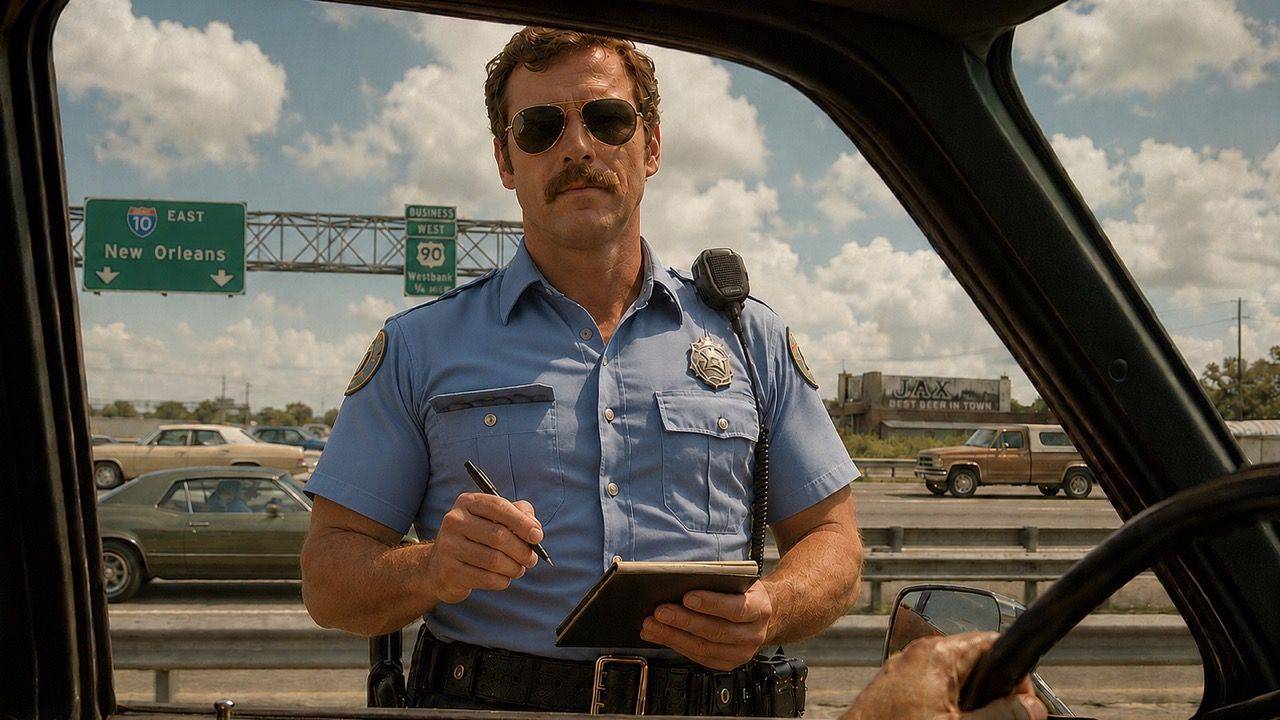
I headed up the ramp, and just as I reached the top, an unmarked police car pulled directly in front of me and blocked the road. Two policemen exited the vehicle and began walking towards my car.
The driver was in plain clothes. The passenger was in uniform, and he already had his ticket book in his hand when he stepped out of the car.
He was wearing dark sunglasses. He had that look. You know, the look that says, "This conversation is going to cost you money."
He walked over to my window and said, “You know you’re not supposed to be up here. You went around the gate arm."
And suddenly, I remembered Larry Pridgen. Unfortunately, I also remembered that I had lost his card. But I thought perhaps the name itself might be enough.
So I said, “Officer, I really don’t like dropping names…”
Which, of course, is what people always say immediately before they drop a name.
“But would it help if I told you I know Larry Pridgen?”
The officer stopped.
He looked at me over the top of his sunglasses.
And in that unmistakable New Orleans accent, he said:
“You know Larry?”
I said, “Yes, sir.”
He said, “How you know Larry?”
So I started telling him the whole story, explaining that I had worked at Brennan’s and how Larry had guarded the front door during Mardi Gras.
I explained that we had gotten to know each other, and that Larry had given me one of his police department business cards.
Then I admitted, “But somewhere over the years, I lost it.”
The officer just kept staring at me with the most puzzled expression on his face.
Then he looked down at his uniform pocket.
When he had pulled out his pen, the pocket flap had folded upward and covered his name tag.
Slowly, he lowered the flap.
And there, directly in front of me, was the name:
L. PRIDGEN.
I had just spent several minutes trying to impress Larry Pridgen by telling him that I knew Larry Pridgen.
There was a pause.
He looked at me.
I looked at him.
And then we both started laughing.
Larry put away the ticket book, reached into his pocket and handed me a stack of his business cards.
He said, “Put these in your glove compartment—and don’t lose them this time.”
I did exactly what he told me.
And while I don’t remember how long I kept those cards, I have never forgotten the day I tried to talk my way out of a ticket by telling a New Orleans policeman that I knew him.
Sometimes the connection you are trying so hard to establish is already standing right in front of you.
Business analogies
1. We sometimes overlook the person in front of us
Businesses frequently focus on titles, résumés, reputations and influential connections while failing to recognize the value of the individual directly in front of them.
Application: Listen before trying to impress. The employee, customer or prospect may already be the person with the authority, knowledge or influence you need.
2. Relationships have value only when they are maintained
Larry’s business card represented a relationship, but losing it illustrated how easily connections fade when they are not intentionally maintained.
Application: A contact list is not a relationship strategy. Relationships require follow-up, communication and continued relevance.
3. Name-dropping is less powerful than genuine connection
I tried to borrow credibility by mentioning Larry’s name, only to discover that the person hearing the story was Larry himself.
Application: Borrowed credibility may open a door, but authenticity, competence and personal trust are what keep it open.
4. Assumptions can make us miss obvious information
The officer’s name tag was covered, so I built an entire strategy without knowing the most important fact in the situation.
Application: Before solving a problem, slow down and gather the facts. Many bad decisions begin with an untested assumption.
5. People remember how you treat them
Larry remembered me years later because our relationship at Brennan’s had been built through hospitality, conversation and mutual respect.
Application: Small acts of kindness and attention often create more lasting goodwill than formal networking efforts. No encounter is truly neutral.
