
You Know Larry?

In the early 1970s, I was an assistant manager at Brennan’s Restaurant in New Orleans.
And Brennan’s was not just a busy restaurant. It was a world-famous restaurant—particularly known for breakfast.
On an average day, we might serve 1,100 or 1,200 people for breakfast and lunch, and another 600 at dinner.
During Mardi Gras, the French Quarter was even more chaotic.
The streets were crowded. People were celebrating. People were drinking. And some people had apparently decided that good judgment was something they would pick up again after Ash Wednesday.
So, during Mardi Gras, Brennan’s hired two off-duty New Orleans police officers to watch the front door.
Over time, I got to know them pretty well. We would feed them, visit with them and give them a little break from the activity outside.
One of those officers was a motorcycle policeman named Larry Pridgen.
At the end of one Mardi Gras season, Larry handed me his New Orleans Police Department business card. He said, “Fred, ke...
Reality Is Reality: What Every Executive Needs to Hear

The boardroom has always had its share of performance. But something has shifted.
With AI-polished presentations, curated LinkedIn profiles, and metrics selectively framed to tell the most flattering story, it has never been easier for leaders — and entire organizations — to mistake image for substance. To confuse the appearance of success with actual results. Mistaking illusion for reality.
That distinction used to matter. Today it is critical.
The Corporate Illusion Machine
Executives are not immune to the illusion economy. In fact, they may be among its most sophisticated practitioners.
Quarterly narratives get polished until setbacks disappear. Culture decks describe organizations that don't exist on the floor. Leadership brands are carefully managed while real problems go unaddressed. AI-generated insights sound authoritative but are built on no genuine organizational knowledge.
The danger is not just bad optics. The danger is that leaders begin believing their own projectio...
The One Percent Problem: What a Hell’s Angel Taught Me About Employee Excellence

Not long ago, I was talking with a CEO I respect — runs a high eight-figure service company — and I asked him how things were going with his people.
He said, almost offhandedly, "Well, you always have that 20% who aren't in step."
He wasn't upset about it. Wasn't looking for a solution. Said it the way you'd say it rains a lot in the spring. Just one of those things.
I couldn't stop thinking about it.
Rewind
Let me take you back to February 5, 1967. Crowley, Louisiana. Small farming town, about 15,000 people, the kind of place where everybody knew everybody and news traveled fast even without the internet.
My friends and I were hanging around the Mug-N-Burger that Sunday afternoon — sitting on the hoods and trunks of our cars, passing around Cherry Cokes and Dr Peppers — when word came through that a group of Hell's Angels had stopped at Morrow's Shell Station out on Highway 90.
We went. Of course we went.
When we pulled up, there were two Harleys under the canopy. One being...
New Tires, Bad Alignment, and the Hidden Risk in M&A

When a company goes through a merger or acquisition, there is often a great deal of excitement around the possibilities.
New opportunities.
New markets.
New capabilities.
New momentum.
It can feel a lot like putting four brand-new tires on a vehicle.
The investment is significant. The expectation is high. Everything about it suggests a smoother ride ahead.
But there is a problem.
If the vehicle is out of alignment, those new tires will not last nearly as long as they should. Tire experts note that improper alignment can cause tires to wear unevenly and prematurely, which means the problem is not with the tires themselves, but with the way the vehicle is set up to carry them.
That is a powerful picture of what happens in many mergers and acquisitions.
The deal may make perfect sense on paper.
The numbers may work.
The strategy may be sound.
The market may respond favorably.
But if the people, cultures, communication styles, and leadership expectations are not aligned, the value begin...
However You Say It, Thank You Means Everything
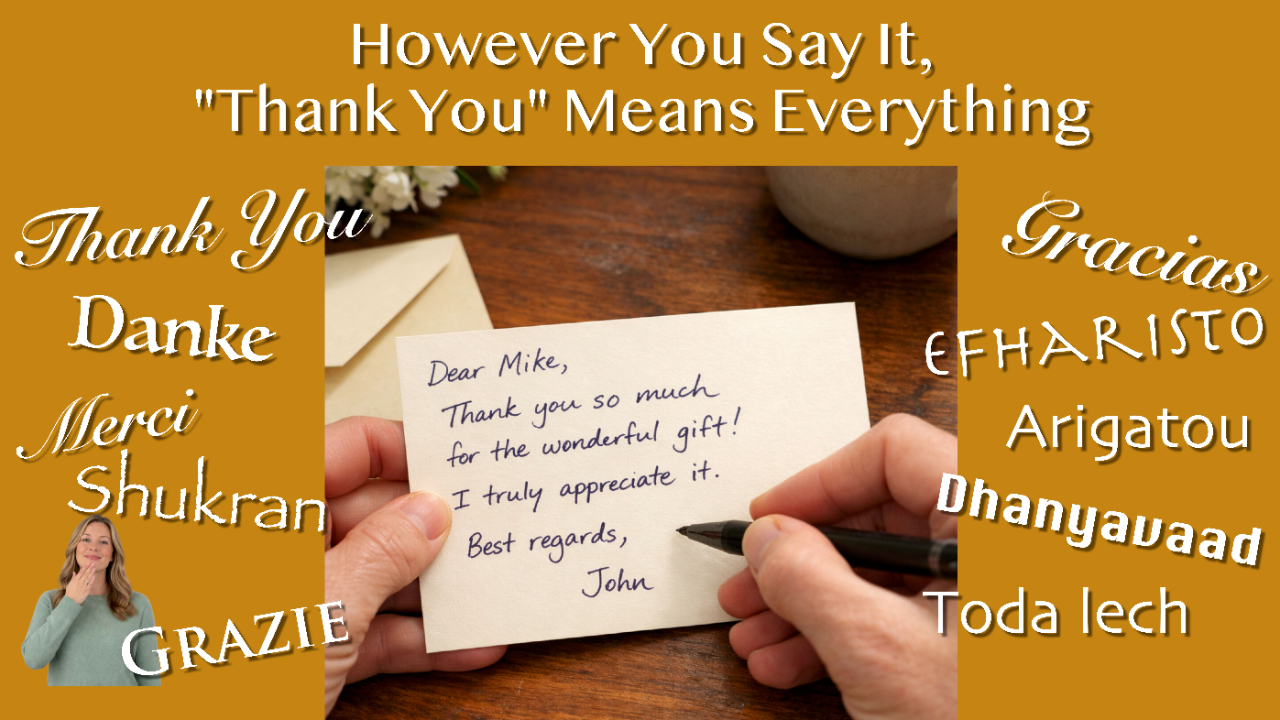
“Thank you.”
“Merci.”
“Grazie.”
“Danke.”
“Shukran.”
Different words. Different cultures. Same meaning.
Across every language, “thank you” carries something universal—gratitude, appreciation, and, perhaps most importantly, acknowledgement. It’s a simple expression, but it does something powerful: it lets another person know, “I see what you did, and it mattered.”
Which is why its absence stands out so much.
Lately, I’ve noticed a growing pattern—not just socially, but professionally as well. Gifts are given, gestures are made, invitations are extended… and nothing comes back. No note. No text. No email. Not even a quick mention the next time you speak.
And while it may seem like a small thing, it’s not. Because this isn’t really about the words “thank you.” It’s about what those words represent.
When someone takes the time to send a graduation gift, celebrate a wedding, acknowledge a birthday, or host you for dinner, there’s intention behind it. There’s thought. There’s effort. And wh...
They Don’t Quit Doing Business. They Quit Doing Business with YOU!

That’s not an easy sentence to read. It’s even harder to accept.
When revenue softens, when a long-standing account suddenly goes quiet, or when a customer who used to be responsive becomes distant, we instinctively look outward. We blame the economy. We blame competition. We blame pricing pressures, market shifts, or the latest technological disruption. In today’s environment, we might even blame AI.
But most of the time, the explanation is far more personal.
Customers rarely quit doing business altogether. They quit doing business with someone who made them feel overlooked, unheard, or unimportant. They won't quit going out to eat; they will stop eating at your restaurant. They won't quit needing banking services; they will stop depositing and borrowing from your bank. They won't quit buying clothes; they will stop buying their clothes from you.
And that difference matters.
Caution: AI Ahead!
We are operating in an era that celebrates efficiency. Automation, artificial intellig...
Ghosting: When Silence Became the New Response

Ghosting: When Silence Became the New Response
And why it’s quietly becoming a crisis in business communication
Not long ago, “ghosting” was a term reserved for dating culture. One person stopped responding, disappeared without explanation, and left the other wondering what happened. It was frustrating, immature, and emotionally unsettling—but it lived mostly in the realm of social relationships.
Today, ghosting has migrated.
And it has taken up residence in the business world.
What was once considered rude or unprofessional has become…expected.
Emails go unanswered.
Texts are read but ignored.
Calls aren’t returned.
Meetings are tentatively scheduled and quietly abandoned.
Proposals are requested and then met with silence.
The absence of response has become a response.
From Social Behavior to Business Norm
Ghosting began as a social behavior tied to discomfort and avoidance. It allowed people to sidestep awkward conversations or difficult decisions. But technology made it easier—too ...
Social Media: The Coke Bottle of the Modern World

In the 1980 classic film *The Gods Must Be Crazy*, the peaceful rhythm of a remote African bushman village is shattered when an empty Coca-Cola bottle mysteriously falls from the sky (actually thrown from a single-engine plane flying above). For a community that lived in harmony, sharing everything and having no concept of personal ownership or competition, the sudden appearance of this foreign object brought unexpected turmoil. What was once a tranquil, cooperative society became a battleground for possession, sparking jealousy, conflict, and a desire for something none of them had ever needed before.
Today, social media mirrors this disruptive force. Like the Coke bottle, it has fallen into our lives seemingly out of nowhere, offering great potential but also unsettling our sense of peace, connection, and self-worth.
The Pre-Coke Bottle Harmony
The bushmen in the film lived a simple, harmonious existence. They had no notion of time as we understand it, no possessions, and no sense...
The Neuroscience of Conversation: Why Talking is Good for Your Brain (and Your Soul)

Conversations aren't just about words. They're about connection, empathy, trust, and all the unspoken magic that happens when two people genuinely engage. Sure, you’ve probably heard the phrase, "It’s not what you say, it’s how you say it." But let’s take it further: it’s what happens in your brain when you say it.
Think about it. Why do some conversations leave you energized and others drain you? Why does talking with the right person at the right time feel like a shot of caffeine straight to the soul?
Here’s the kicker: neuroscience shows us that conversation is way more than chit-chat. It’s a workout for your brain. And like all good workouts, the results are real, even if you don’t see them right away.
What Happens in Your Brain When You Talk
Picture this: you’re deep in a meaningful conversation. Not small talk, but the kind of chat that makes you think, makes you feel. Behind the scenes, your brain is lighting up. Different parts of your brain—the prefrontal cortex, the amygd...
12 Important Questions to Ask in Job Interviews

NOTE: Before going into any job interview, it is critical to first conduct a thorough research of the company where you are seeking employment.
These are 12 insightful questions you can ask during your next interview to showcase your genuine interest, strategic thinking, and initiative:
About the company and role:
- "What are the biggest challenges and opportunities this team is currently facing?" This demonstrates your proactive nature and interest in contributing meaningfully.
- "How would you describe the company culture, and how does it foster collaboration and innovation?" Shows interest in the work environment and potential for cultural fit.
- "What are the key metrics used to measure success in this role, and how will I be supported in achieving them?" Indicates goal-oriented thinking and desire for clear expectations.
About your potential impact:
- "Beyond the responsibilities outlined in the job description, are there any areas where you see an immediate need for my skill...
